
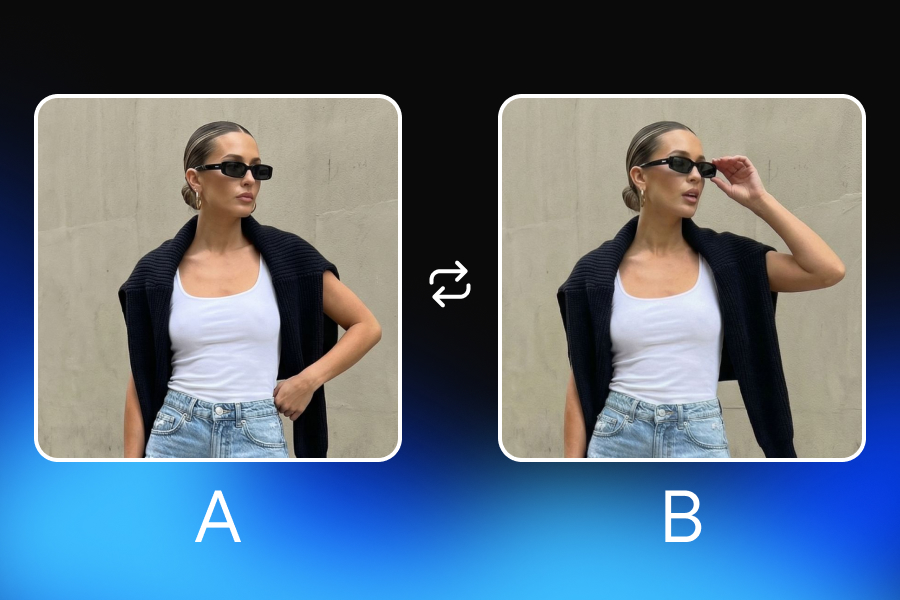
Launching a product without testing your visuals is a little like launching an ad without knowing the headline.
It might work.
But you're relying on guesswork instead of data.
For years, A/B testing focused almost entirely on pricing, copy, and landing pages. Today, product images have become just as important. In many cases, your visuals are the first thing customers notice—and often the deciding factor in whether they keep scrolling or start exploring your product.
The good news is that A/B testing product images has never been easier.
The challenge is knowing what's actually worth testing.
Many brands waste time experimenting with changes that have little impact while overlooking the visual elements that genuinely influence buying decisions.
This guide explains where to focus your testing, what realistic improvements you can expect, and how AI-powered workflows make continuous image optimization possible.
Why Product Images Matter More Than Ever
Customers make purchasing decisions faster than ever.
Before reading a product description or checking specifications, they usually form an impression based on the first image they see.
That first impression shapes everything that follows.
A product photo doesn't just show what you're selling—it communicates quality, trust, professionalism, and brand value.
Even small visual improvements can influence how customers perceive your products.
That's why leading e-commerce brands rarely rely on a single product image anymore. Instead, they continuously test different visual approaches to understand what resonates with their audience.
What Should You Actually Test?
One of the biggest mistakes brands make is changing everything at once.
If multiple elements change simultaneously, it becomes impossible to understand what influenced the results.
Instead, focus on testing one variable at a time.
For example, you might compare a clean white background with a subtle lifestyle setting to see which creates more engagement. Another test could evaluate whether customers respond better to a close-up hero image or a wider composition that shows the product in context.
Lighting is another surprisingly influential factor. Soft, natural lighting often creates a warmer and more premium feeling, while brighter studio lighting can improve clarity for certain categories.
Even the angle of a product can make a measurable difference. Jewelry, cosmetics, fashion accessories, and home décor products often perform differently depending on whether customers first see a front-facing image, a detailed close-up, or a lifestyle composition.
The objective isn't simply finding the most attractive image.
It's discovering which visual presentation encourages customers to take the next step.
Lifestyle vs. Studio Images
This is one of the most common tests brands run.
Studio images are clean, distraction-free, and excellent for showing product details. They're often the preferred choice for marketplaces and catalog pages.
Lifestyle images create context. They help customers imagine owning or using the product.
Neither approach is universally better.
A premium watch might perform best with elegant lifestyle photography, while replacement phone accessories may convert better with clean studio images that clearly show compatibility and product details.
Testing both approaches often provides valuable insights that vary by product category and customer expectations.
Backgrounds Matter More Than You Think
Backgrounds don't just affect aesthetics—they influence perception.
A minimal neutral background often communicates simplicity and luxury. Natural environments can create warmth and authenticity. Bold colors may attract attention but sometimes distract from the product itself.
Rather than asking, "Which background looks best?" ask, "Which background helps customers understand and trust the product?"
That subtle shift in thinking often leads to better testing decisions.
Don't Ignore Product Order
Many brands spend time optimizing individual images while overlooking something much simpler:
the order they're displayed.
Sometimes moving a lifestyle image from fourth position to second creates a bigger impact than redesigning the image entirely.
Likewise, placing a detailed close-up earlier in the gallery may answer customer questions before they even reach the product description.
Testing image sequence is often faster—and cheaper—than creating entirely new visuals.
What Are Realistic Benchmarks?
One of the biggest misconceptions about A/B testing is expecting dramatic improvements from every experiment.
That's rarely how optimization works.
A successful image test might improve click-through rates by a few percentage points or increase product page engagement enough to produce meaningful long-term gains.
Not every experiment will produce a winner.
Some tests will show almost no difference.
Others may even reduce performance.
That's completely normal.
The goal of A/B testing isn't to prove assumptions.
It's to replace assumptions with evidence.
Over time, those small improvements compound into significant business results.
Why Speed Matters in Testing
Traditional product photography makes continuous testing difficult.
Every new concept often requires additional photography, editing, approvals, and production time.
By the time new visuals are ready, the campaign may already be over.
AI-assisted workflows change that dynamic.
Instead of waiting weeks to test a new background or campaign concept, brands can quickly generate multiple realistic variations from existing product assets and begin collecting performance data almost immediately.
This allows creative decisions to be driven by results rather than intuition.
The Cost of Not Testing
Many brands think they're saving money by using the same product images everywhere.
In reality, they may be missing opportunities.
If a slightly different hero image increases conversions, improves click-through rates, or keeps visitors on the page longer, the long-term impact can easily outweigh the cost of producing additional creative assets.
The biggest expense isn't creating another image.
It's continuing to use an underperforming one simply because it has never been tested.
Why AI Makes Continuous Testing Possible
AI isn't valuable because it replaces photographers.
It's valuable because it removes production bottlenecks.
Instead of creating one or two versions of a product image, brands can experiment with multiple lighting styles, backgrounds, compositions, aspect ratios, and campaign concepts while keeping the product itself consistent.
That dramatically reduces the time between an idea and a live test.
More importantly, it encourages continuous optimization instead of one-time production.
Building a Smarter Testing Workflow
Successful brands don't treat A/B testing as an occasional project.
They make it part of their creative process.
Rather than creating a single "perfect" product image, they build several strong variations, launch them, measure performance, learn from the data, and repeat the process.
That workflow creates a steady cycle of improvement.
As product catalogs grow and marketing channels expand, managing all those assets manually becomes increasingly difficult.
This is one reason platforms like Adject are designed around reusable assets, connected projects, and workspace-based editing instead of isolated image generation. Rather than recreating visuals from scratch, brands can quickly build, organize, and test multiple commercial variations while keeping products consistent across campaigns.
For teams running frequent experiments, having a structured creative workflow can be just as valuable as generating the images themselves.
Final Thoughts
There is no universal "best" product image.
The image that performs best for one audience may perform differently for another.
That's exactly why A/B testing matters.
Instead of relying on personal preference, successful brands let customer behavior guide creative decisions.
Start with one change at a time. Measure real results. Keep what works, discard what doesn't, and continue refining your visuals as your business grows.
In e-commerce, the brands that improve consistently often outperform the brands that simply create beautiful images.
Because the goal isn't to design the perfect product photo.
It's to build a visual system that gets better with every test.

