
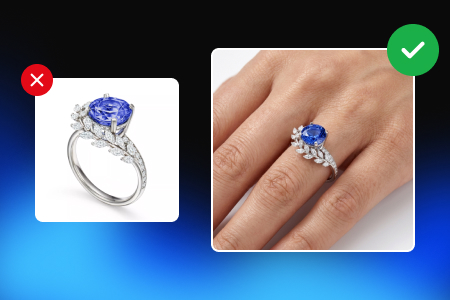
Most e-commerce brands assume that if a product isn't converting, the problem must be the price. Or maybe the copy. Sometimes it's the reviews. So they rewrite the product description, launch another discount campaign, or spend more money driving traffic to the page.
But there's another possibility that's surprisingly easy to overlook: customers simply aren't confident enough to buy.
Every online purchase comes with uncertainty. Unlike physical stores, customers can't pick up a product, examine the materials, compare its size, or see how it looks under different lighting conditions. Everything they know about your product comes through a screen.
That's why product images do far more than showcase what you're selling. They replace the experience of holding the product in someone's hands. When that experience is incomplete, customers hesitate.
And hesitation is one of the biggest conversion killers in e-commerce.
Your Product Gallery Isn't a Gallery. It's a Conversation.
Think about the last time you bought something online that you had never seen in person. Did you immediately scroll down to read the specifications? Probably not.
Like most shoppers, you likely started with the images. You swiped through the gallery. You zoomed in. You searched for another angle. You looked for a photo showing the product in someone's hand or inside a real environment.
Without realizing it, you were asking questions:
What does it actually look like?
How big is it?
Will the material feel premium?
Does the color look the same in normal lighting?
Can I imagine owning this?
Every image that answered one of those questions moved you closer to buying. Every unanswered question moved you closer to leaving.
That's why the best-performing product pages don't simply have beautiful photography. They have complete visual storytelling.
More Images Don't Increase Conversions. Better Answers Do.
One of the biggest misconceptions in e-commerce is that adding more product images automatically improves conversion rates. It doesn't.
You've probably seen product pages with fifteen photos that all look almost identical. The camera moves a few degrees. The lighting changes slightly. The background stays the same.
Technically, there are plenty of images. Practically, the customer hasn't learned anything new.
Every image should introduce new information. If two photos answer exactly the same question, one of them probably doesn't need to exist.
The goal isn't building a larger gallery. It's reducing uncertainty.
Introducing the Confidence Ladder™
The highest-converting product pages tend to follow the same invisible pattern. Whether they realize it or not, they're guiding customers through a series of questions.
We call this the Confidence Ladder™.
Each image removes one layer of uncertainty until the customer feels comfortable making a purchase. Instead of thinking about product photography as a collection of pictures, think about it as a sequence of answers.
The first image answers: “Is this the product I'm looking for?
The second answers: “Does it actually look premium?
The third answers: “How large is it in real life?
The fourth answers: “How would I actually use it?
The fifth answers: “Can I trust the quality?
The final images answer the most important question of all: “Can I picture myself owning this?
That's the real purpose of a product gallery. Not showing more. Removing doubt.
The Hero Image Has One Job
Many brands try to make their first product image do everything at once. They add dramatic lighting, decorative props, text overlays, and lifestyle elements.
The result often looks beautiful. But it doesn't communicate clearly.
Your hero image has one responsibility: help customers immediately recognize the product. Within a second or two, shoppers should understand exactly what they're looking at.
Nothing more. Nothing less.
Clarity always beats creativity on the first image. Creativity becomes much more valuable later in the gallery, once the customer already understands what the product is.
Customers Need Proof, Not Perfection
One reason many product galleries feel incomplete is because they only show the product when everything is perfectly controlled: perfect lighting, perfect angles, and perfect backgrounds.
Ironically, this can reduce trust.
Customers know products don't exist inside photography studios. They exist inside homes, offices, kitchens, wardrobes, and everyday life.
That's why some of the strongest-performing images are often the least “perfect.” A coffee mug sitting naturally on a breakfast table. A handbag being carried through a city street. A candle placed on a bookshelf during the evening.
These images don't just showcase the product. They answer an important psychological question:
“What would this look like in my life?”
That's often the moment when browsing turns into buying.
What the Highest-Converting Product Galleries Have in Common
If you compare product pages from some of the world's best e-commerce brands, you'll notice something interesting. The products may be completely different. One brand sells handmade candles. Another sells premium watches. Another sells furniture. Yet the structure of their product galleries is surprisingly similar.
That's because they all understand the same principle: every image has a purpose.
The first image captures attention. The next one builds confidence. The following images remove uncertainty. And by the time the customer reaches the end of the gallery, they've already answered most of the questions they would normally ask in a physical store.
That's not accidental. It's intentional design.
The mistake many brands make is treating every product image as equally important. In reality, every position inside the gallery plays a different psychological role.
The First Three Seconds Decide Everything
Most visitors won't consciously analyze your first product image. They'll react to it. Within seconds, they've already started making assumptions about quality, price, and trustworthiness.
This is why your opening image shouldn't try to tell the whole story. Its only job is to make the product instantly recognizable. Everything else comes later.
Once that first impression has been established, customers naturally begin asking more detailed questions. How large is it? What does the texture actually look like? How does the material reflect light? What does the back look like? How does it fit into everyday life?
A strong gallery answers these questions one at a time instead of overwhelming visitors with information all at once. That's exactly how good salespeople work in physical stores. They don't explain everything immediately. They answer the customer's next question before it's even asked.
Stop Showing the Same Product. Start Showing Different Perspectives.
One of the easiest ways to spot an underperforming product gallery is repetition. You swipe through six images only to realize you've essentially seen the same photo six times. The camera moves slightly. The background changes. Maybe the lighting becomes warmer. But nothing new has actually been communicated.
Customers don't need six different views of the same information. They need six different reasons to feel confident.
Imagine you're selling a handmade leather wallet. Instead of uploading six similar product shots, each image could tell a different part of the story. One introduces the wallet itself. Another highlights the leather grain and stitching. A third shows the wallet inside someone's pocket to establish scale. A fourth reveals the internal compartments. A fifth demonstrates how it looks during everyday use. The final image might show the packaging, reinforcing the premium buying experience.
Notice what's happening. The customer isn't simply seeing more photos. They're building understanding.
That's what increases confidence.
Context Often Sells Better Than Detail
Many brands spend enormous effort photographing every tiny feature of a product. Sometimes that's useful. Sometimes it's unnecessary.
Customers don't buy products because they understand every specification. They buy because they understand how the product fits into their lives.
This is where contextual imagery becomes incredibly powerful. A dining chair doesn't become more desirable because you've shown another angle of the legs. It becomes more desirable when customers see it inside a beautifully designed dining room where they can immediately imagine their own home.
The same principle applies across almost every category. A skincare bottle feels more trustworthy sitting naturally on a bathroom counter than floating inside a perfectly generated abstract background. A handmade ceramic bowl feels more valuable when it's part of a breakfast table rather than isolated against pure white.
Context answers emotional questions. Product photography answers technical ones. The best galleries combine both.
Zoom Is One of the Most Underrated Conversion Tools
Here's something many brands overlook. Customers who zoom into product images are often among the most purchase-ready visitors.
They're actively looking for reassurance. They want to inspect stitching. Read labels. Examine textures. Check material quality.
If those details aren't available, uncertainty increases. And uncertainty almost always slows purchasing decisions.
That's why close-up photography isn't about creating artistic images. It's about reducing risk.
A customer who can clearly inspect the craftsmanship of a handmade bracelet or the texture of a premium fabric has fewer unanswered questions than someone relying solely on wide product shots.
Every successful zoom interaction quietly reinforces trust.
The Product Isn't the Only Thing Customers Are Evaluating
This is perhaps the most overlooked idea in e-commerce photography. Customers aren't only judging the product. They're judging your business.
Without realizing it, people make assumptions like:
“If this brand invested this much care into their photography, maybe they also care about product quality.”
Or the opposite:
“If the product images look rushed, what does that say about everything else?”
Product galleries communicate professionalism long before customers read your About page. They're often your strongest trust signal.
That's one reason premium brands maintain such consistent visual standards across every product page. Consistency doesn't simply look better. It makes the entire business feel more reliable.
Why AI Changes More Than Production Speed
Much of the conversation around AI focuses on creating images faster. That's certainly valuable. But speed isn't the biggest opportunity.
Consistency is.
Traditionally, creating an entirely new product gallery meant scheduling another shoot, rebuilding lighting setups, editing dozens of new images, and coordinating creative teams. Today, brands can build much richer galleries from a single high-quality product asset while maintaining the same visual identity across every variation.
Instead of recreating products, they're expanding stories.
That distinction changes how creative teams think about content production. Rather than asking, “Which photos do we still need?” they begin asking, “What customer questions haven't we answered yet?”
That's a much more valuable creative process.
The Most Common Mistake: Treating Every Product the Same
One reason so many product galleries fail is that brands copy what everyone else is doing. If a competitor uploads eight product images, they upload eight too. If another brand uses a white background for every photo, they do the same.
The result is a gallery that looks perfectly acceptable—but completely forgettable.
Customers don't compare your images against a checklist. They compare them against their own uncertainty.
A handmade leather bag doesn't need the same visual story as a skincare serum. A luxury watch shouldn't be presented the same way as a kitchen appliance. Even two products within the same category may require completely different galleries depending on what customers care about most.
The question isn't: “How many images should we upload?”
It's: “What questions does this particular customer still have?”
That's where high-converting galleries separate themselves from average ones.
The Best Product Pages Feel Like an In-Store Experience
Walk into a premium retail store and notice what happens. Nobody hands you a specification sheet the moment you walk through the door.
Instead, they let you see the product. Then they encourage you to touch it. If you look interested, they'll answer your questions, explain the materials, demonstrate how it works, and highlight the details that matter most.
It's a conversation.
Great product galleries work exactly the same way. The first image attracts attention. The next image builds curiosity. The following images remove hesitation.
By the end of the gallery, the customer has already experienced something remarkably close to interacting with the product in person.
That's the real purpose of product photography.
Not decoration.
Simulation.
The better your visuals recreate the confidence of shopping in a physical store, the less work your product description has to do.
Why the Future Isn't About More Photos
For years, improving product pages meant organizing another photoshoot. Need a seasonal campaign? Schedule another shoot. Launching a new color? Book another photographer. Running a summer promotion? Time for another production.
That approach worked when brands created content occasionally.
Modern commerce doesn't work like that anymore.
Products appear across dozens of customer touchpoints. Marketing campaigns change constantly. New platforms appear every year, and creative teams are expected to produce more content than ever before.
The bottleneck is no longer photography.
It's production.
Successful brands are beginning to think less about creating new images and more about extending the value of the images they already have.
A single high-quality product asset can become the foundation for product pages, social campaigns, email marketing, marketplace listings, seasonal promotions, paid advertising, and short-form video content.
That's not just more efficient.
It's more consistent.
From Product Photos to Product Systems
Perhaps the biggest shift happening in e-commerce is moving away from individual images and toward connected visual systems. Instead of treating every campaign as a new creative project, leading brands are building reusable libraries around their products.
Each product becomes a living asset that grows over time.
As new campaigns launch, new formats are needed, or customer behavior changes, brands expand that existing asset instead of starting from zero.
This creates something incredibly valuable: consistency.
Customers may discover a product through Instagram, revisit it on your website, receive it later in an email campaign, and finally purchase after seeing a remarketing ad. The environments change. The story evolves. But the product always feels familiar.
That consistency builds recognition.
Recognition builds trust.
And trust is one of the strongest drivers of conversion.
Where AI Fits Into the Picture
Much of the discussion around AI still focuses on image generation. But for e-commerce brands, image generation is only the beginning.
The real opportunity lies in what happens after that first image exists.
Can you adapt it for different campaigns? Can you preserve product accuracy while creating new compositions? Can your team build seasonal content without recreating the entire production process? Can marketing, design, and e-commerce teams work from the same visual foundation?
These are workflow questions rather than AI questions.
That's why the conversation is gradually shifting away from generating more content and toward managing creative production more intelligently.
This is also the philosophy behind Adject.
Rather than functioning as another AI image generator, Adject is designed as a visual workspace where products become reusable creative assets. Teams can build complete product image sets, adapt them for different platforms, create new campaign variations, and keep every version connected to the original product instead of scattering files across multiple tools and folders.
For growing e-commerce brands, that means spending less time recreating visuals—and more time improving them.
Final Thoughts
The highest-converting product pages rarely have the most images. They have the right images.
Every photo answers a question. Every answer removes uncertainty. Every reduction in uncertainty moves a customer one step closer to making a purchase.
That's why the best product galleries aren't built around photography.
They're built around customer confidence.
As content demands continue to grow, successful brands won't compete by uploading more product photos than everyone else. They'll compete by creating smarter visual experiences—experiences that educate, reassure, inspire, and ultimately make buying feel easy.
Because at the end of the day, customers don't purchase products after seeing enough images.
They purchase products when they feel they've seen everything they needed to make a confident decision.

